| |
 |
|
|
In the summer of 1982, during the Israeli invasion
and the siege of Lebanon, Palestinian poet Mahmoud Darwish wrote:
“‘I won’t be leaving,’ I say, ‘ because
I don’t know where I’ll be going, I won’t leave.’”
Then he asks a person he calls ‘F’, “And you?”
And F answers, “‘I’m staying. I’m Lebanese,
and this is my country. Where am I to go?’”1
F’s reply suddenly makes Darwish become aware of his status
as an exile, and the void created in a space where his home was
supposed to be. Darwish was born in Upper Galilee, present- day
Haifa in Israel. During the 1948 Arab-Israeli war, he and his family
fled to Lebanon.2 This seemingly distant event cannot
be distanced from the tragedy that took place here in New York.
Since 1982, the U.S.-Israeli relationship has been constantly provoking
the Arab world’s antipathy toward this country. Later, this
exile from Galilee for thirty-one years writes: “We have traveled
like other people, but we / return to nowhere / we have a country
of words.”3
Because of political and economic conditions, nearly 100 million
people are displaced from their geographical boundaries of home,
and this unparalleled level of demographic change is profoundly
challenging our world’s most basic notions of community, nation,
culture, and citizenship.4 For many émigrés,
home is no longer a physical geographical boundary, but where their
memory resides.
If words are home to a Palestinian exile, visual expression can
be regarded as a home to Allan deSouza, a second-generation immigrant.
No single country claims deSouza, who was born in Kenya to Goan
parents. His family’s move from their home, the former Portuguese
colony of Goa, India to Kenya was mainly for economic reasons. With
Kenya’s independence, the deSouzas moved to Great Britain,
and currently deSouza resides in Los Angeles. In his ongoing series
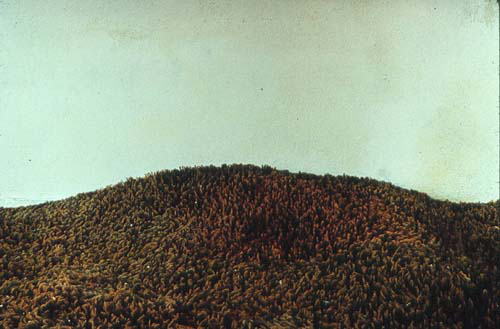
of works begun in 1999, entitled Terrains, deSouza creates fictional
landscapes—what he calls “fabricated, tabletop landscape
models” (Fig. 1). The void as homeland also exists in deSouza’s
works. Being twice removed from his place of birth, deSouza has
a strong longing for a homeland. As he described it, Terrains is
an effort to “externalize those emotions of longing to undo
their hold [and] view them from a distance.” He obsessively
introduces objects from everyday life, often from his own body,
such as earwax, eyelashes, and fingernail clippings, in his artificial
landscapes. DeSouza then photographs such fabricated landscapes,
computer-scans the negatives, and manipulates them in the manner
of painting. Such painstaking acts to reclaim the void, the longing
for and belonging to home, by fabricating imaginary landscapes,
open up a new page in the American landscape tradition.
In Allan deSouza: Recent Works, held at Talwar
Gallery , one room exhibited such works dealing mainly with
body parts. Filling the void with a particular presence—such
as his bodily detritus—and using photography, deSouza’s
work can most effectively be interpreted from the photographical
index. Traditionally, the paintings can be regarded as Symbolic,
as it enters into human consciousness through pictorial representation
by forming a connection between objects and their meanings. This
relationship, however, does not apply to photography, because photography
is the result of a physical imprint, or index, transferred by light
reflection onto light-sensitive paper. The separation of the image
from the actual presence of the object disallows the process of
schematization. Photography is a place, filled with signification,
that operates between different shifters and becomes the culture
of reception.5
The “shifter” is a category of linguistic signs introduced
by the linguist Roman Jacobson, which is filled with significance,
only because it is empty. The word ‘this’ is such a sign,
waiting each time to be supplied with its referents. The personal
pronouns ‘I’ and ‘you’ are also shifters that
shift according to their users. Because of its nature, in the early
development of a child, the acquisition for the uses of the shifter,
“I” and “you” is the last thing to be correctly
learned, and often, in the case of speech in autistic children,
the use of personal pronouns collapses and becomes reversed.
DeSouza, however, moves one step further from the photographical
index through the added process of image manipulation. DeSouza deliberately
fabricates the Symbolic with a falsehood in order to expose another.
For example, in his rhetorically fashioned landscape photography,
which resembles nineteenth century barren landscape paintings, in
comparison to representative nineteenth century American Romantic
landscape paintings, such as the works by Thomas Cole, we see that
his work does not convey any fixed ideas. Rather it presents its
readers with something uncanny; in many cases, it even betrays our
expectation of finding any representations of landscape. In this
process, the reader ought to fill a falsehood with signifiers from
his or her own reservoir to produce meaning in deSouza’s landscape.
Such process heightens the reader’s reception toward the constitution
of Symbolic, as often, the Symbolic entails both historical and
social frameworks preexistent to the reader’s own being.
Leading a nomadic life, deSouza has a rather ambiguous cultural
identity. Usually, as pointed out by the Palestinian-American intellectual
Edward Said, culture serves as a source of identity, helping us
to see ourselves, our people, and tradition in the best light. “In
time,” Said writes, “this differentiates ‘us’
from ‘them.’”6 Such is not the case for deSouza.
Here, we may expand the concept of shifter from personal pronouns
to geographical boundaries or countries. As deSouza moved from one
continent to another, every time, the shifter changed and produced
a different significance, resulting in a complex vision.
This flux in vision generated by living in different parts of the
world gives deSouza a good reason to challenge the Symbolic that
exists in any given society. For example, his deliberate use of
the nineteenth century pictorial American landscape tradition questions
the social and cultural constitutions of the U.S. In the nineteenth
century, American Romanticism played an active role in establishing
a specific American identity. According to the art historians James
Soby and Dorothy Miller, American Romantic tradition “came
into being in London with Benjamin West, as part of the European
movement, and brought to this country in the early 19th century.”7
The art historian Oswaldo Roque makes a similar observation. British
cultural identity, therefore, is crucial in the establishment of
American identity. Roque also sees that major human concerns, such
as a people’s morality, a nation’s mission, and the future,
found their way into works of art in this period.8 Such ideas
presented by the artist find ways to connect to the establishment
of nationalism. For example, a nineteenth century former mayor of
New York, Philip Hone, said: “I think every American is bound
to prove his love of country by admiring Cole. ”9 This statement
confirms for us the connection between culture and nationalism.
Remembering that the Romanticism in America began as part of the
European movement, in terms of institutional nationalism, the U.S.
worked from European models to fabricate a linear historiography
since the time of independence. On the other hand, America is an
immigrant settler society superimposed on the ruins of a considerable
native presence, and American identity is too varied to be unitary
and homogenous. DeSouza’s seeming adherence to the nineteenth
century landscape tradition is a re-examination of the notion of
unitary identity, and linear and subsumed history, where he sees
the whole as complex, hybrid, heterogeneous, and un-monolithic.10
A Blurring of the World, a Refocusing Seconds, Minutes, Hours, Days
Maybe Years Later, with Everything Put Together Differently, in
Ways He Doesn’t Understand, is the latest work by deSouza exhibited
at Talwar Gallery. The title suggests how our perception of an event
alters by different moments, and finally becomes something entirely
different from what originally had took place. This specific work
evokes the event that took place on the morning of September 11th.
However, as one recovers from the initial shock caused by this work,
one discovers that the scene is composed of mischievously arranged
discarded computer chips, thin blue lines, inserted images of the
flickering flames and the tailing smoke. There are no Twin Towers
or crashing airplanes depicted here. Much of what evokes the events
of 9/11 owes to the power of mass media that has harped incessantly
on the unbearable suffering, consequently evoking a chilling patriotism,
and reasserting a worn-out nationalism in a multiracial, and multicultural
environment.
In reality, only the title of the work came after September 11th,
forging a more concrete relationship between the work and the tragedy.11
DeSouza happened to create this work about a month prior to the
9/11 event, when he traveled and lived in Donegal, Ireland and heard
about sectarian violence that takes place in Northern Ireland.
DeSouza’s American landscape manifestation, which does not
seek to forge any concrete connection between objects and their
meanings, operates contrary to the traditional relationship between
object and idea entailed in painting. This traditional relationship
often insistently connects culture and nationalism. Such insistence,
as Said points out, only ends up in the “awful din of unending
strife, and a bloody political mess.”12 On the other hand,
keeping in mind the concept of “shifter,” we recognize
that “self” and “other” can also be regarded
as artifice. DeSouza’s fictional homeland, constituted of his
memories and thoughts living a nomadic life, works to reveal contradictions
inhabiting static or Symbolic ideas in a given society, and thus
brings the world into more layered and complex place.
Sources>>
Author's Bio>>
|
|









