| by Lisa Jaye Young |
 |
|
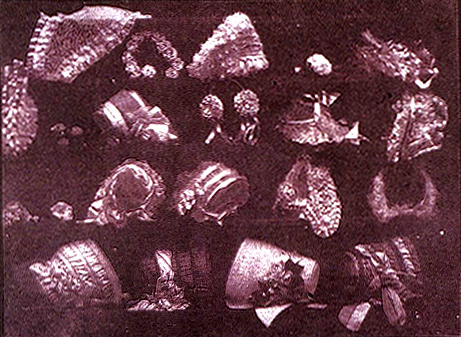
Talbot. The Milliner's Window
|
To take an inventory implies accounting for one's possessions and listing objects in relation to their identity as expressions of and testaments to ownership. Most often the owner or possessor of an inventory is a merchant or storekeeper, but an inventory may also be a formal list of the property of a person or estate, a tally of personal traits, aptitudes and skills, or an evaluation "of one's life and accomplishments." 1 Taking an inventory, in a sense, is not so very different than taking a photograph in that each produces a testimony that acts as a marker of objects in "possession" for a certain duration, whether that time is a lifetime or the time of exposure. The photograph as an inventory is a notion which begins with photography's own beginnings in the work of William Henry Fox Talbot, for whom photography itself was in part an inventorial activity. In the following discussion I will focus on the idea of the "inventorial photograph" 2 and its function in Talbot's work. The term "inventorial photograph" may be understood as a photograph which records not only possessions, but details and tonal differentiations. In a sense it is the photograph as "secretary and clerk" 3 which Charles Baudelaire, twenty years later, would deem the acceptable arena for photography. However, I will argue that even this diminutive function of a photograph as "hand-maiden" is not limited to the realm of pure practicality, but serves to open up the medium as a site of comparison for objects and natural phenomena. It is a space to understand a photograph as a visual grid of temporal-spatial dimensions, and as a testament to lived experience. In other words, the inventory is not an end but a means toward understanding photographic structure. My intention is not to claim that all photographs mimic an inventorial function, but rather to borrow from the practice and individuality of history's first photographer in order to further problematize the mechanics of photography; in essence, a kind of structural exercise in complicating the inventory of functions and definitions which constitute Photography as a medium. I will look at Talbot's inventorial photographs of specialized objects such as glass and china vessels, figurines, books, and hats as a case study for investigating the relationship between inventory-taking and the taking of photographs.
As Carol Armstrong has extensively discussed, Talbot's experimental method of photographing was largely influenced by Sir John Herschel's natural philosophy as a comparative and accumulative system of learning. In his Preliminary Discourse, Herschel delineates that "the first step toward understanding is to accumulate a sufficient quantity of well-ascertained facts, or recorded instances, bearing on the point in question. Common sense dictates this, affording us the means of examining the same subject in several points of view." 4 With this system in place, based on the collecting, recording, and comparison of data and viewpoints, Talbot was inclined to approach, and indeed to inventory, photography itself as an instrument for the inventorializing of data and viewpoints. The structure of Photography understood as such (with the guiding light of Nature) turns images into depositories of facts, recorded instances, points of view, measures of light sources, chemical combinations, and times of day - a virtual inventory in and of itself. Every detail is both recorded in his journal (written in ink) and registered on the surface of the photograph itself (written in light). But what does it mean to consider photography as an inventory?; and how is our understanding of photography expanded when thus considered? Is it reduced again to its documentary status as record-keeper and hand-maiden?; or can it be broken down into various inventorial functions and thereby expanded as a unique medium?
 |
|
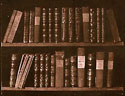
Fig. 2: A Scene in a Library
|
Of Talbot's photograph "A Scene in a Library"(fig. 2) on plate VIII of his book, The Pencil of Nature, Armstrong writes that this image
...is an inventorial photograph, and the object of its inventory is the author's library, the same library in which The Pencil of Nature itself surely would be included. Self-reflexively, "A Scene in a Library" images the world of books into which the photograph would be inserted, as well as the relationship between printed text and the photograph's capacities that would structure such books, and even the manner in which those books are put together.5
One might expand on this object of a photograph's inventory by asking the following questions: what other aspects are built into the inventorial photograph as a strategic format? What is the structural capacity of Talbot's inventorial photograph beyond its relation to the printed word? On multiple levels of self-reflexivity, how does the inventorial photograph (in particular) engage in the meaning-making and inventory-taking of its author and its viewer while simultaneously defining the practice of Photography itself? On this level, Professor Armstrong elaborates: "...Talbot's instructions ask us to read the photograph self-reflexively, as an image of photography, defined as a surface full of imaged detail, deriving from the action of Nature and serving as a temporal index of the history of the material it records," 6 suggesting that the self-reflexivity of Photography is both a matter of indexing surface (or space) and history (or time). Continuing in this vein, I will consider the intersection between the spatial (the surface) and the temporal (the historical index) that exists both in an inventory and in a photograph. Fragmenting the notion of an inventory into (some of) its shared photographic aspects or parts - and here I have chosen to concentrate on the inventorial notions of comparison, display, the grid, and the record or monument of the self - we can investigate how photography structurally resembles the notion of inventory.
Inventory/Photography as Site of Comparison
 |
|
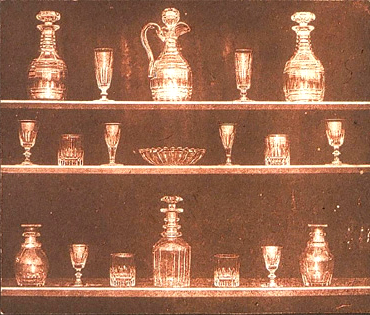
Fig. 3: Articles of Glass"
(Plate IV in The Pencil of Nature)
|
An inventory is a site of comparison. It is a surface or catalogue on and in which difference and similarity can be registered. As a system of organizing facts and recording the existence of objects (or people), an inventory is part of the nineteenth-century scientific preoccupation, contemporaneous with Talbot's own projects, with systems of taxonomy and classification in accordance with Comte's third means toward a natural method, that of comparison. 7 The one after another, one above or below the next, format employed in many of Talbot's compositions encourages and reenforces comparison as a method for looking at, not only the objects within the photographs, but the photographs themselves as a body or site of comparison. Talbot's "Articles of China"(Plate III in The Pencil of Nature) illustrates this interest in comparison as Carol Armstrong again points out. Talbot's caption "commences by comparing this photograph to a written inventory." 8 Talbot emphasizes that the camera is mute, but fast, and has the unique ability to depict variously "strange and fantastic" 9 forms all-at-once. Talbot's emphasis, then, is on a new site (the photograph) as an intersection of space in the form of surface elaborations and time in the form of instantaneity. In a sense, not only are shapes, functions, and sizes being compared, but also time and space. The time and space of writing is compared to that of photography. The space of the photograph is compared both to the real time of its making and to the contrasted time and space of its viewing. A pendant photograph, "Articles of Glass" (Plate IV in The Pencil of Nature) (fig. 3)is also compared to "Articles of China" as they are separated by only one page in his book. Thus glass is compared to china in terms of how rays of light reflect the form and line of a vessel of differing manufacture and material. A balanced composition in each image, encourages the eye's movement from side to side, resting on glasses of apparently similar function, but with slightly differing details and shapes. One unique piece in the center, a circular glass dish with a petal-like, rimmed design holds its place as an axis around which the eye may spin in the act of comparison, encouraging constant movement and shifting in viewing.
Michel Foucault famously discusses "Natural History in the Classical Age" as, in essence, inventories and sites of comparison: "unencumbered spaces in which things are juxtaposed: herbariums, collections, gardens....present themselves one beside another, their surfaces visible, grouped according to their common features." 10 Foucault continues to emphasize this dynamic writing that: "from the seventeenth century there can no longer be any signs except in the analysis of representations according to identities and differences." 11 Photography, then, as a branch of this history of juxtaposition, and as a practice based in scientific pursuits, makes its debut through Talbot as a comparative medium between the photograph and Nature, between objects, between scenes or individuals within one image, between photographs themselves, and between the spaces and times of production and consumption. A photograph by Niecephore Niepce, "The Table Setting" (c.1827), considered by many to be the very first photograph, is worth looking at as perhaps an initiator (and potential example for Talbot) of Photography as fundamentally a site of comparisons with its objects of various shapes and sizes: spoon, knife, wine glass, bottle, pitcher, bowl, etc., each producing a different shadow, tone, or highlight. Talbot's "Tabletop" of 1840, as a similar still life subject and arrangement of "facts of light" on various objects, highlights this comparison and perhaps suggests Photography's "nature" as one of comparisons.
Inventory/Photography as Display
Secondly, an inventory as a record of collecting and comparing assumes
the application of a system of difference and resemblance and as such
demands a certain dynamic of display, a dynamic which requires both a
displayer and a viewer. Talbot's example of "The Milliner's Window"
(not included in The Pencil of Nature) (fig. 1), allows the display
dynamic to operate on various levels which overlap with the territory
of comparison, of the grid, and of the testament to the self, thus also
pointing to the artificiality of the divisions I have outlined here in
the breakdown of inventory for the sake of argument.
The title "The Milliner's Window," automatically evokes one of the most common scenes of display, the shopkeeper's window or showcase. It is only an evocation however because of the title's status as make-believe. A grouping of ladies' bonnets is presumably arranged for display and eventual purchase. A many-tiered scenario is played out in which the title suggests a shop window where these hats are for sale, available for a price. The viewer is free to peruse the shapes and styles, the textures and details. She may imagine her choice and its cost. Yet we know from letters and other background material on Talbot that the actual scene of this photograph is that of an arrangement of bonnets out of doors at Lacock Abbey, all belonging to Lady Elizabeth Feilding, Talbot's mother. The title is one of fancy supplied by Lady Elizabeth, establishing her, in a sense, as one of the authors of the photograph. For Talbot, we might assume, the essential idea was to set up a display of objects as specimens upon which light would act and where the photographic result itself is also a specimen that would display the camerawork of detail and simultaneous representation. "The Milliner's Window" is thus a virtual inventory of the narratives or subjects which are able to coexist within the space of a single photograph. It is a make-believe display of a fictional character's shop window, a mother's display of her possessions as aspects of her person (she owns the bonnets), a photographer's display of the range and ability of his craft as a surface inventory of details, shadows, and highlights, and a son's display of his own heritage and of his mother's influence and indulgence.
Peter Wollen writes that "visual display is the other side of the spectacle: the side of production rather than consumption or reception, the designer rather than the viewer, the agent rather than the patient" 12 However, in relation to "The Milliner's Window", I would argue that the visual displays announced by the photograph and its title engage both sides of the spectacle, both sides of the photograph, that of the two designers/producers and their counterpart, the viewer/consumer. Each side of the photograph engages in the production of meaning and becomes enmeshed and interwoven into the subject matter of the image as display.13
In keeping with the parallel between a photograph and
an inventory or collection of details and objects, we might look to Susan
Stewart who writes that "the collection...compels the consciousness
of the observer to enter into the consciousness of the collector"
14 I would argue that this notion mirrors Photography, as the
consciousness of the viewer and of the photographer enter into a private,
visual contract of meaning production by which subjectivities are enmeshed
and contested, collapsed and discerned.
"The Milliner's Window", then, provides an example of the meshing
and overlap of both subject matters and subjectivities inherent in Talbot's
photographs, and metonymically, in photography as a medium. One hesitates,
however, to introduce the subjectivity of the viewer into this incestuous
brew of claims already complicated by the narratives of mother, son, fictions,
and facts. But, of course, the viewer is introduced as both the imagined
(by mother and son) and the actual audience or "believer" of
the scene as shop window. The viewer is therefore implicit in the playful
production of the photograph as both viewer and customer. The viewer incorporates
her own more removed subjectivity by stepping into the viewing position
of the author/photographer, but is free to provide her own interpretation
of and identification with the given scene. The viewer is compelled to
relate the photograph back to his or her own subjective experience. An
entire inventory of possible meanings, intentions, and personal histories
is collapsed into a single image.
This photograph, temporally removed from its moment of production, assumes a many-times-removed identity today as a souvenir of Talbot's own heritage, relating both photography and what it depicts tautologically back to his own person. As an index or residue of a lived experience (or lived experiment, in Talbot's case), Talbot's photographs act like souvenirs. Susan Stewart, in her discussion of the souvenir, writes that "...the memory of the body is replaced by the memory of the object, a memory standing outside the self and thus presenting both a surplus and a lack of significance..." 15 She continues: "The presence of the object [here, both the photograph and the bonnets themselves] all the more radically speaks to its status as a mere substitution and to its subsequent distance from the self." 16 Like the souvenir on display, both the inventory and the photograph serve as markers of memory, makers of memory, and substitutes for the display, the event, the life itself, an idea to which I will subsequently return.
Inventory/Photography as Grid
"...The organization of the collection itself replaces time. And no doubt this is the collection's fundamental function: the resolving of real time into a systematic dimension." -Jean Baudrillard 17
An inventory is comparable to the format of a grid. The
grid, as a common twentieth century format for displaying, organizing,
recording, and inventorying goods, images, data and details, is the manifestation
of recorded facts onto a two-dimensional surface. It is, loosely according
to Webster, a system of reference, of coordinates, or a framework for
the storage of information. 18 The photographic surface itself,
like a grid,
may be seen as an abstracted, flattened, quadrilateral inventory of marks
and punctures, and patches of shadows and highlights which are compared
and contrasted, displayed, categorized and recorded. Talbot points toward
a photograph's ability to inventory objects and details by organizing
his articles in a loose, grid-like format; one object following the next,
one object above or below another, posed for comparison and contrast.
At once multiplied and unified, his objects are held in place in grid-like,
imperfect columns and rows, signifying their own display value, their
artifice as positioned Nature, and Photography's ability to inventory
as such.
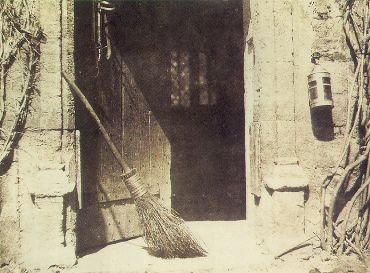 |
The grid format, as discussed by Rosalind Krauss, is a twentieth century invention in art, yet its basis is an impulse stemming from eighteenth and nineteenth century systems of classification and taxonomy. Where Krauss emphasizes that the grid in Art announces the surface of a painting or a drawing, it seems to me also that the nature of photography as a medium of surfaces, in tandem with its capacity as record-keeper, likewise behaves as a grid. Krauss explains that "the grid appears in Symbolist art in the form of windows, the material presence of their panes expressed by the geometrical interventions of the window's mullions." 19 Talbot, in suggesting the fictional window in "The Milliner's Window," does not need to supply the gridded panes of glass, they are implied by the captioned title as an organizing principle and reference to both format and subject. The idea of the window thus stands in for photography itself as a format for displaying and organizing objects, as a framing device, as something with both surface and depth, and as an instrument of reflection. In "The Milliner's Window", the idea of window (for as we have seen, there is not an actual window here, but only a fictional one) stands in as the photographic framework, whose perimeters become the frame itself and whose imagined glass doubles as the lens of the camera. The imagined window provides the gridded framework for both the subject(s) of the photograph, and self-reflexively, for photography as a medium. In fact, the metaphor of the window can be seen as an underlying motif or framework throughout Talbot's entire career. One recognizes Talbot's references to the photo-apparatus as window in examples such as "The Open Door." (fig. 4) The open door, the background interior window, its reflections of light on the ground, and the centered, window-like framed cut of the photograph itself constantly refer the viewer back to the camera's aperture and again to the human eye as both window onto the world and into the soul. The window motif is picked up again and again in Talbot's "View of the Boulevards at Paris," his various views of Lacock Abbey, and in a work which Buckland calls the earliest negative in existence, "The Latticed Window," taken by Talbot with the camera obscura in 1835. By depicting and emphasizing in a letter of the time the camera's ability to re-produce the many square panes of a window and the whole window at once, Talbot stresses his interest in the part-to-whole condition of both Nature and a photograph as represented by a gridded windowpane:
No matter whether a subject be large or small, simple or complicated; whether the flower-branch which you wish to copy contains one blossom, or one-thousand; you set the instrument in action, the allotted time elapses and you find the picture finished, in every part, and in every minute particular. 20
Talbot compares the camera's ability to a natural wonder, continuing:
There is something in this rapidity and perfection of execution, which is very wonderful. But after all what is Nature but one great field of wonders past our comprehension! Those, indeed, which are of everyday occurrence, do not habitually strike us, on account of their familiarity, but they are not the less one that account essential portions of the same wonderful Whole."21
Krauss writes:
As a transparent vehicle, the window is that which admits light - or spirit - into the initial darkness of the room. But if glass transmits, it also reflects. And so the window is experienced [by the Symbolist] as a mirror as well - something that freezes and locks the self into the space of its own reduplicated being.22
A parallel with photography is suggested.23 Photographs, like frozen blocks of life, lock the self as photographer and the self as viewer into a visual continuum, privileging the fragment or cut from reality as both transmitter and reflector of subjectivity.
Even though I am not suggesting that every photograph may be read in terms of the grid in either Talbot's work or any other photographer's, the framed quadrilateral cut that photography makes, its abstraction from and indexing of its referent, its serial propensity, and Talbot's continuous reference to the window structure, make this comparison compelling. The photograph, acknowledges its surface and its literal frame of reference, yet compels the viewer beyond its scope, just as "the grid operates from the work of art outward, compelling our acknowledgement of a world beyond the frame." 24 Each catalogues, inventories and acts as an index for its referent, substituting for the once-there objects.
Inventory/Photography as Testament to the Self
I have addressed individual photographs (within Talbot's work) as collections,
as flattened, organized objects, details, and marks, but what of his collection,
"body", or inventory of photographs as a whole? Do they "add
up" and if so, what do they attest to beyond their nature as a "first"
in the history of photography? At the (or rather one) crux of Talbot's
experiments in photography is the desire for preservation; the preservation
of not only histories and collections, views and structures, but also
of the Self. At the onset of his diaristic notes of his experiments he
writes: "The most transitory of things, a shadow, the emblem of all
that is fleeting and momentary, may be fettered by the spells of our 'natural
magic' and may be fixed forever in the position which it seemed only destined
for a single instant to occupy." 25 Talbot's own life,
as a fleeting and transitory shadow, is fixed onto the pages of The
Pencil of Nature even if its captions or text do not disclose his
project autobiographically as such.
Talbot had a strong sense of self and of destiny. From a very young age, at the age of eight, he instructed his stepfather not to allow his mother or anyone else to throw away his correspondence with them. If we look to Baudrillard's above quote and consider Talbot also as collector of objects and images in addition to being a producer, how do Talbot's photographs materialize as markers of real time and private dimension? Talbot's original ideation of photography sheds light on his notion of Photography as a solution for durability, the kind of durability which outlives a human life. His original desire was to achieve a fixed image, a fixed record of an object on paper, more durable than "a mere souvenir." 26 Along these lines, Jean Baudrillard discusses the durability of a collection: "the object is the thing with which we construct our mourning: the object represents our own death..." He continues...."a person who collects is dead, but he literally survives himself through his collection, which (even while he lives) duplicates him infinitely, beyond death, by integrating death itself into the series, into the cycle." 27 In this sense the collection, or the inventory, and photography as an act of image collecting and preserving, all perform the task of monumentalizing or marking the that-has-been which Roland Barthes discusses as unique to the photograph. In Talbot's case, his choice of subjects to demonstrate and memorialize photography simultaneously delineate and memorialize his own existence.
Talbot's photographs (perhaps especially his inventorial photographs), and his overall project of inventorying the medium, participate in the recording of the various aspects of his own, private and public self. Talbot does not directly allude to this reading of his photographs, however each scene in The Pencil of Nature points in some fashion back to the person, Henry F. Talbot. The Oxford College scenes reference a highly educated man; various scenes and views used to elucidate photography's potential functions are taken at his ancestral home, Lacock Abbey; the inventory photographs reference his own collections; examples of ancient writing point to Talbot as a scholar of etymology and philology; and plant leaves index his role as an amateur botanist. From this angle, the book becomes a not-so-veiled self-reflexive monument, not only to photography, but to a man's life, the importance of his heritage, and his history, not to mention his making of photographic history. He could have arbitrarily chosen impersonal subject matter to accomplish his demonstrations of the potentialities of photography and photographic illustration, but he chose instead to depict markers of his own existence, thus formulating an alternative, autobiographical subject for his publication.
In regard to the "Articles of China," we are told by its caption that these are specimens (already a textual act of genericizing or de-personalizing by way of scientific terminology) or examples of how photography might record "the whole cabinet of a Virtuoso and collector of old china...on paper in little more time than it would take him to make a written inventory describing it in the usual way." 28 Yet, as we know Talbot to be a gentleman collector and antiquarian, the details and shapes unique to each of these teapots, teacups, the lattice basket, the urns, the figurines, and especially the two china figures in repose on their tiny chaises (see the photograph of "Lady Elizabeth Fielding on her chaise lounge" of 20 April 1842 as a comparison), point us back to their owner and to the nature of these objects as choices, tokens of travel abroad, or gifts, each with its own specific and unique physical history (or what Walter Benjamin would call, "testimony") in relation to the photographer. Each object, like the larger photographic inventory in which it participates, is a marker of memory, the author's memory: this pitcher was perhaps a Christmas gift from mother, that bowl was a wedding present from Kit, this urn marks my first trip to Tuscany, etc. Each object in its own right and the collection as a whole perform as an index to the aura of each piece's physical objecthood and the collective aura, or sum total, of its possessor's once-lived life.
In addition, by concluding The Pencil of Nature with a reference to the values of portrait photography ("What would not be the value to our English Nobility of such a record of their ancestors who lived a century ago?"), 29 Talbot underlines his book as a "noble" self-portrait within and alongside its more scientific and experimental functions. As heirlooms, articles of glass and china, statuettes, and hats, etc. function, like a photograph, as objects through which to pass on important information about family events, heritage, and occasions. Although not made explicit by Talbot until the end with his suggestion of the photograph's value for future generations to see their ancestors, the conjunction between such objects of inventory and the inventory kept by photographs, seems of vital importance to his project. It is almost as if the trace of memory (in the form of preservation, evidence, written description, inventory of precious objects, and recorded details) underlines Talbot's entire project. It is the need to make a durable imprint, to fix something so that it may be remembered and seen that is photography's both possible and impossible task.
Talbot fuses his own identity with that of photography, thereby proving the priority of his discovery in relation to Daguerre and also demonstrating (even if un-self-consciously) a new type of subjectivity unique to photography, that is, a subjectivity not only bound to the authoring of an image, as in painting, but one which collapses the subjectivity of author and reader, and collapses at times the author and the objects he photographs. Photography, from its Talbotian inception, then, is not only a natural recorder of scientific objectivity and authenticity, recording the traces, and markings of Time, of wear, of ownership, etc. but also a record of subjectivity and artifice, of the hand that set the stage or the eye that chose a scene or a view over and above all others.
My essay concludes with the following questions which
remain unresolved and speak to the, as yet and perhaps permanently, unresolved
nature of my own understanding of the medium: How is one to remain true
to Talbot's photography as a project of scientific experimentation, demonstration,
elucidation of specimens, chemical actions, shadows, and light and also
act as a reader, reading Talbot's subjective position into the images
and simultaneously one's own position of subjectivity as viewer into the
work? In other words, how does photography suspend and support such different,
yet parallel, activities?; and if The Pencil of Nature attaches
"photography to the spectator over and above the operator,"
30 then is it possible to re-attach the operator in Talbot's
case?; and if so, how does this complicate or compromise a photograph's
meaning? Of what does photography's simultaneity consist?; and is this
layering effect of subjects, narratives, and frameworks, at once multiple
and unified, a quality unique to photography?