No
Respect:
Review of Women Designers in the USA, 1900-2000
by Janna Eggebeen
|
|
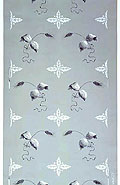
Fig 1: Wallpaper and textile
patterns are the most typical types of design featured in the exhibition.
Nancy McClelland. Wallpaper, c. 1930-50. Block-printed by Mauny, Paris; distributed by Nancy McClelland, New York. Paper. Cooper-Hewitt, National Design Museum, Smithsonian Institution, Art Resource, NY. Gift of the Museum at the Fashion Institute of Technology (1998-75-65). Photo: Matt Flynn |
Women Designers in the USA, 1900-2000, an exhibition
at the Bard Graduate Center for Studies in the Decorative Arts in New
York, was organized by Pat Kirkham. A 462- page catalogue edited by Kirkham,
with contributions by leading scholars, accompanies the exhibition. The
stated goals of the project are to celebrate women's achievements in design
and to address the roles of gender, class, race, and training in the practice
of design. Although a laudable enterprise, the project Women Designers
is deeply problematic.
The first issue is Kirkham's inclusive definition of design. Exhibited with more-or-less typical examples of industrial and product design (appliances, posters, chairs, and textiles) are items of fashion, interior design, landscape architecture, and film costume and production design. Also prominent are objects traditionally considered crafts: quilts, basketry, pottery, and jewelry. Most of the "designers" featured in the exhibition would doubtless be surprised and even affronted by that designation.
Design can be a very amorphous term, as is evident by the collections of hatboxes, silverware, Homer oil sketches, and yads at Cooper-Hewitt, National Design Museum. However, design as a catch-all category for an exhibition makes for a motley assortment of stuff. Dis-united under the rubric "diversity and difference" and shoehorned into small galleries, the objects don't say much to each other or to the viewer.
An overly expansive concept of design is compounded by an equally narrow representation of works. Kirkham relates that although Bard Director Susan Weber Soros and board member Shelby White had proposed the idea of an exhibition on women designers, they were skeptical when she told them it would be necessary to limit its scope. Kirkham confined the project to designers who worked in the United States during the twentieth century. And she restricted the exhibition to only one work from each designer. This seemingly egalitarian approach backfires in the presentation. The only selection criteria appear to be those of gender, date, and location. There is little attempt to treat or interpret objects aesthetically. The exhibition is clearly not about the products of design; it is about the producers of design.
 |
|
Fig 2: There are very few appliances, such as Lisa Krohn's
"phonebook", designed by women. |
The catalogue ameliorates some of the problems of the exhibition by telling the stories of the designers. It has essays on African American women designers and Native American women designers, as well as essays on women designers in various media: metal, ceramics, textiles, and so forth. (The separate discussion of "minority ethnic" women is meant to counteract the "eurocentrism" of design scholarship.) However, by choosing to focus on the designers, the catalogue struggles to find an alternative to the "heroes" paradigm set up by the design field's most well known historian, Nikolaus Pevsner. The catalogue claims to counter the canon-forming approach of Pevsner's Pioneers of Modern Design, which saw design history in terms of progress towards Modernism. Yet Women Designers has a narrative too; its story is the triumph of feminism.
One aspect of the catalogue is particularly disagreeable. A timeline, called a "Context Line", notes miscellaneous information involving twentieth-century American women. Like the exhibition, little attempt was made to select items of importance or which have any bearing on each other. It is hard to make anything of the fact that in 1904 Lena and Lydia Burton Conley protested against plans to build on a Native American burial site, or that Seventeen magazine was founded in 1944 and that Ellen DeGeneres declared herself a lesbian in 1997. The benefit of being able to present in the catalogue more nuanced "herstories" is mitigated by the same lack of selective criteria affecting the exhibition.
|
|
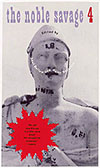
Fig 3: Graphic design--of
which Elaine Lustig Cohen's cover is an early representative--is
prominent in the exhibition. Elaine Lustig Cohen. Cover for The
Noble Savage 4, 1959. Offset lithograph. Cooper-Hewitt, National
Design Museum, Smithsonian Institution, Art Resource, NY. Gift of
Tamar Cohen and Dave Slatoff (1993-31-37). Photo: Matt Flynn
|
There is one question that Women Designers alludes to, but does not address: What is the place of design? Material culture historian Cheryl Robertson once told me that she often describes design as "the stuff in your house." Indeed, design in the form of appliances, furnishings and interiors is intimately intertwined with the domestic environment. Proficiency in design and skill in the decorative arts were long viewed as suitable "accomplishments" for bourgeois women and a means of support for working-class women. Therefore, a number of schools in design or its various branches were set up for women at the end of the nineteenth century. In the twentieth century, the amateur, domestic nature of most design and the anonymity of company staff designers proved a fertile field for women.
Design, as a profession, is a relatively recent development.
Early male industrial designers of the thirties, such as Henry Dreyfuss,
Raymond
Loewy, Donald Desky, and Norman Bel Geddes, had backgrounds in set design,
fashion illustration, or store window display. They had to actively promote
themselves and sell manufacturers on the advantages of design. Nonetheless
they were considered merely product stylists since their job was essentially
to add eye appeal. The Museum of Modern Art's landmark exhibition of 1951,
Good Design, featured springs, propellers, and meat grinders that
spoke of Le Corbusier's notion of a process of "mechanical selection"-of
the engineer rather than of the designer.
The point is that while the practice of design may be gendered--with women discouraged from working with hard materials such as metal or wood, for example--the field itself has historically been "feminized" by both industry and academia. In the art historical hierarchy, the functional object holds the status of a minor or decorative art rarely worthy of serious study. In practice, design is all too often reduced to product styling.
|
|
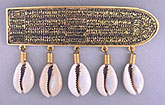
Fig 4: This brooch by Phyllis
Marie Bowdwin is an example of "ethnic minority" design
in Women Designers in the USA, 1900-2000.
Phyllis Marie Bowdwin. The Middle Passage, African Holocaust, Maafa brooch, 1993-96. Brass and cowrie shells. Produced by Who Deserves it More Than You?, New York. Cooper-Hewitt, National Design Museum, Smithsonian Institution, Art Resource, NY. Museum Purchase from Monet Jewelry Fund (1997-3-1). Photo: Matt Flynn |
The catalogue's flap copy promises a discussion of "famous
designers" such as Maria Martinez, Bonnie Cashin, Elsa Peretti, and
April Greiman. Never heard of them? You are not alone. On one hand, this
lack of name recognition is due to the broadening of the terms of design
to incorporate Pueblo potters and fashionistas, jewelers and typographers.
On the other hand, it points out women designers' obscurity in a field
where identity is paramount. The catalogue of Women Designers is
a valuable source in illuminating the careers and historical context of
American women designers, although it ignores the larger issue of recognition
for the field of design. Perhaps the main reason that women designers
such as Maria Martinez are not household names is not entirely due to
their specialization or their gender, but because design has not really
entered public or academic discourse.
© 2001 PART and Janna Eggebeen. All Rights Reserved.