John Crawford's Queens College Marker: The Abstraction of Ideas and the
Idea of the Abstract Monument
by Herbert R. Hartel, Jr.
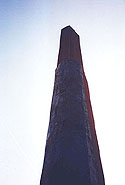 |
Slender yet towering, massive yet elegant, John Crawford's Queens College Marker is a monument's monument. When erected on the campus of Queens College in Flushing, New York, in August of 1994, it instantly became, at nearly 27 feet and 75,000 pounds, one of the largest public sculptures in New York City. It engages the functions of commemoration, awareness, and enlightenment that monuments are expected to perform, but also adopts less conventional purposes and meanings, particularly the experience of abstract form and philosophical speculation, that might be considered the realm of high modernism but not public memorials. Completely non-representational and essentially Minimalist in spirit, Crawford's column could become a test case of the viability of abstraction as meaningful public art in the aftermath of controversies surrounding public art projects that have included, among others, Richard Serra's Tilted Arc. In also continues a tradition of symbolic, expressive meaning in Minimalism long after the movement ceased to dominate what was considered radical in the visual arts, as seen in such well-known works as Maya Lin's Vietnam Veterans Memorial.
Queens College Marker is a column formed by three vertically stacked blocks of solid carbon steel that are unpainted, unpolished, and in the process of rusting. At 26.5 feet in height, the column is nearly three stories tall. Each block is nearly equal in length to the others, and all are vaguely oval in their cross-sections. The column never exceeds three feet in width. It is placed in the center of a slightly convex, circular mound of grass twenty feet in diameter. This area of grass is located in a concrete walkway which constitutes a small plaza sandwiched between two large buildings on the campus, Rosenthal Library (to the west) and Powdermaker Hall (to the east). This plaza is located in the middle of a north-south axis of pedestrian traffic established by entrances on opposite ends of the campus. Several feet to the west of the sculpture but still located on the circle of grass are five boulders, each one approximately two feet high and three to four feet in width.
Crawford has said that "there is a lot of sculptural poetry in how things are joined together. This installation is not about tightening a few bolts." 1 The bottom segment of the sculpture, forged without benefit of machinery which would create streamlined planes and contours, is a broad, squat form, whose surface curves continually with no hard edges. This piece, the least rusted of the three, is a dark gray, with scratch-like patches of glowing orange rust scattered across its surface. The transitions from segment to segment are accomplished by abutting or interpenetrating the columns at different places along their bottom or top edges. Where two segments abut and one hangs over the other slightly, the steel has been rough- or hand-forged (it has not been shaped with machines); where two segments smoothly interlock, the steel has been smooth-or machine-forged (it has been shaped by machine).2 The middle segment has been forged in both ways. Three planar areas have been cut down its eastern side. This gives this segment a leaner, more streamlined quality, a sensation of rapid motion that helps to draw your eye farther upward. The western side of this segment is continuously curved and is oxidized to a rich orange hue. The top segment is entirely smooth-forged, making it the sleekest, most geometric, most mechanical part of the sculpture. Its entire surface is oxidized to a rich orange, making it seem the brightest in hue. Five planar surfaces have been cut down its sides.
By being placed slightly off-center in a major walkway on the campus, this steel tower can be seen so intimately that the viewer can walk up and touch it, or it can be seen as remotely as two hundred feet away. It can also be seen in fragments from many windows in the two buildings which flank it. Although the fragmentary window views do intrigue, they are not very satisfying because the full impact of the work depends on viewing it in its entirety. From any distance the sculpture adamantly yet gracefully makes its existence known. The solemn, poignant presence of the sculpture cannot be ignored as it towers in the otherwise bland but functional plaza.
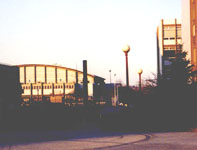 |
The proximity of the walkway affords convenient views at ten to twenty feet away. When viewed from this distance, one can achieve the most engaging sculptural experience the work permits. The shifting orientation of the three segments, their variety of planar surfaces, colors, and textures, and the transition from a rough-forged surface at the bottom to a smooth-forged one at the top are visually exciting and absorbing, offering a wide range of beautiful abstract sculptural experiences. The possibilities are expanded by walking slowly around the sculpture as you look at it continuously or repeatedly. In doing this the work takes on new life, for changes in perspective provide changes in shape, size, and the arrangement of forms. The marker seems to soar to the sky, even though it is also firmly rooted in the soil. It seems to twist in different directions from segment to segment, yet it is motionless. Its steel surfaces can be dismally gray or brightly orange, as changes in light alter changes in mood. At a distance of a few hundred feet the sculpture is sometimes distilled to a dark silhouette. This effect is especially noticeable at twilight or at night.
Crawford was born in 1953 in New York City to an artistically-inclined family. His father was the Precisionist painter Rawlston Crawford and his mother and two brothers are photographers.3 Ironically, Crawford gravitated toward sculpture, but a difference in media does not assume a difference in sensibility. Crawford would agree, for he credits his father with instilling in him a fascination with visual structure and the belief that structure is essential to meaning.4 Crawford earned a B.F.A. in sculpture from the Rhode Island School of Design in 1976 and then worked as an apprentice to blacksmiths in Italy for ten years. As an apprentice blacksmith, Crawford learned pre-industrial, manual techniques of working with metals in a sixteenth century, water-powered forge, where he made farming tools.5
Before apprenticing as a blacksmith, Crawford built abstract figures out of wood logs.6 Crawford said that he chose to learn blacksmithing because he has long been interested in tools.7 In Italy, Crawford began to work in iron (in return for his services to the blacksmiths he was able to use the forge to make his own sculptures), and his work of this period includes pieces which reflect the look and function of farm tools and others which are more architectural in style. The architectural objects include arched forms, forms held together by tension or compression, and forms held together with iron pins serving as joints. They typically include bold arrangements of a few block- or rod-like pieces of iron reaching in various directions. Much of Crawford's work reveals his keen interest in the physical characteristics of materials, and in the architectural, mechanical, and industrial. Crawford's interest in structure extends beyond the man-made to that found in nature, such as the structure of minerals, including the geometric structure of iron pyrite crystals, which can be described as fractals. These structures are evident in the spatial arrangements of some of Crawford's sculptures. These visual explorations of structure are for Crawford an attempt to find order and harmony in life. Important examples of Crawford's work in iron prior to the Markers include 3 Legged Arch #7 (1984) and Braced Form #16 (1984-86).
Queens College Marker was commissioned by Queens College for its Benjamin Rosenthal Library, which opened in 1988, in fulfillment of the Percent for Art Program of New York City. The committee established to obtain art for the Rosenthal Library, headed by chief art librarian Suzanna Simor, considered 11,000 artists and solicited 150 proposals before choosing the proposal submitted by Crawford.8 The cost of the project was $100,000.9 The sculpture was constructed at Scot Forge in Spring Grove, Illinois, where it was initially forged, and then at the Rose Corporation in Reading, Pennsylvania, where the process of forging was completed.10 Queens College Marker is less commonly known as Marker I-4, which for the sculptor means the fourth marker he has made in iron.11 Although the sculpture was installed as its basic design was described by Crawford in his original proposal, as "a tower of forged, machined billets of steel" with "three interlocking pieces," it underwent considerable change before installation. Crawford originally planned for it to be placed on the opposite side of the library, in a ravine one-story deep on the northwest corner of the building which flanks the windows of the reading room in the first floor.12 At one time he also intended the sculpture to consist of four segments. Crawford wanted one connection point visible to the viewers in the reading room of each floor (they are directly overhead from floor to floor) as the sculpture rose alongside the building to the fourth floor.13 Crawford thinks this plan had intriguing possibilities, but has no regrets that the committee eventually decided to relocate the sculpture, a decision which led him to drop the four-segment design in favor of the three-segment plan.14 Both decisions proved to be wise ones. The original location for this work is secluded; no matter how effective it may have been there, it would have been experienced by far fewer people. If the sculpture consisted of four segments and therefore would have been appropriately longer, it might have become disconcertingly tall.
Queens College Marker is part of a series of sculptures Crawford calls Markers, which he began making in the late 1980s. Crawford has made several markers in iron, tin, and wood. Some are as small as scale models while many range in size from four to seven feet tall. These works frequently consist of a few block- or slab-like forms that are sometimes juxtaposed with or held aloft by a few rod-like forms. The works feature both human and architectural proportions and offer a rich array of abstract sculptural experiences due to the forthright and intimate arrangements of their blunt, faintly geometric forms. Crawford's first monumental, site-specific markers were the sculptures he designed for Amherst College in 1990. These works are called Markers because they refer to the desire of all people to produce enduring evidence of their existence for those who follow them; as Crawford says "the desire to leave your mark is very strong."15 The sculptures have been more profoundly and obviously influenced by prehistoric, northern European stone monuments such as Stonehenge, the Dolmens, and the Stone Circles of Carnac. Crawford says "the megaliths are for me a poetic tool for understanding the world and man's self-appointed centrality in that order, and the fractal structures are a less egocentric form for that same understanding. We are each the center of a universe and at the same time peripheral participants in immense patterns."16 He says he "wants you to see these expressions as humanity trying to place itself, trying to derive meaning from all this."17
Crawford wants Queens College Marker to be appreciated for the sculptural experience it provides as well as for the spiritual, philosophical meanings it contains, meanings which originated in his oeuvre in the earlier Markers. He has described the sculpture at Queens College as "a visual poem" that "holds the space" of the plaza.18 However, in his proposal for the project, the sculptor clearly intended a more symbolic meaning as well. He writes that the three segments and their transition from rough-forged to smooth-forged "are a metaphor for a journey, be it life, education, enlightenment. The tower is also a marker, a cairn on a mountain path, a symbol of a man's accomplishments--his attempts to define himself and place himself and leave evidence thereof for those who follow." 19 The shift from rough-hewn to smooth-contoured clearly symbolizes transformation and transition. It is possible to think of this as a shift toward more advanced technology and increased industrialization, and thus the work can become a metaphor for a broad theme in world history. Located on a college campus, between the library and the building that houses most of the social sciences departments, this symbolism acquires certain other connotations. A shift toward greater refinement alludes to learning, to sharpening or "refining" one's mind, to acquiring greater knowledge and understanding. Crawford would not deny these meanings, but he would discourage the viewer from ever dwelling on them because he thinks that to emphasize any singular, literal meaning diminishes the aesthetic experience of the sculpture. The great virtue of Queens College Marker is that various meanings, aesthetic as well as thematic, are completely unified and delicately balanced in powerful abstract form.
A mammoth form of rusting steel as public art would automatically bring to mind Richard Serra's Tilted Arc. Crawford acknowledges that he and Serra use similar materials, but insists that he is dealing with a different set of ideas. How will Crawford's work be received and understood, in the aftermath of this infamous controversy of public art? To date no objections have apparently been voiced, and with good reason, for Crawford's work offers a strong argument for a pleasurable, engaging aesthetic experience made possible by rusting metal. Unlike Tilted Arc, this sculpture has been placed in an area of this walkway that would not receive pedestrian traffic and because of its narrow width it does not obstruct the view of surrounding buildings. It is placed to the side of the pedestrian pathway; it cannot be ignored yet it does not impede activity and movement.
The sculptor has said that "hopefully people will see something in this [Queens College Marker] that gives them a sense of beauty and order." 20 Such meanings are also fundamental to the prehistoric monuments so important to Crawford's thinking. Stonehenge, for instance, may have been a clock, and thus it was a tool--keeping in mind tools are also of interest to Crawford--for understanding time. Crawford's Markers are meditative forms, and the Queens College Marker is especially so. Moreover, it is solemn, poignant, and even somewhat melancholy. This quality originates in the deliberately rusting surface, which metaphorically alludes to the passage of time and the fading of all things into nothingness that is a function of time. Since the Markers are deliberate attempts to make known the existence of the generic someone or something at any one time or place, then the Marker at Queens College fully embraces the function of commemoration that all monuments since the dawn of civilization have been expected to perform. However, the metaphoric implications of the rusting surface indicate that monuments and markers are caught in a battle they can never win; they try to preserve that which is unpreservable and to make eternal that which is transitory. According to Crawford, the rusting alludes to humanity's "way of falling apart." 21 Thus a tone of melancholy persists, and such melancholy is foreign to public monuments, since it self-destroys the purpose for which the monuments were originally created. However, the work is not entirely pessimistic in meaning, for through its very presence in the plaza, Queens College Marker fights to preserve the possibility of commemoration, to reject the disappearance of all things in time. Crawford has said that "hopefully, this will be a focal point, a marker that will help recall monuments."22 The sculpture reminds us that ultimately all monuments are markers in purpose and spirit. Since it purifies and embodies the concept of commemoration that is fundamental to monuments as a human endeavor of prehistoric origin, Queens College Marker is a monument's monument, for it monumentalizes the commemorative and it commemorates the monumental.
References:
1. Queens College press release on Marker I-4.
2. John Crawford in an interview with the author conducted in Dec. 1994.
3. Ibid.
4. Ibid.
5. Nadelman, Cynthia, John Crawford: Markers (New York: Sculpture Center, 1990), n.p.; Queens College press release on Marker I-4.
6. Marilyn J. Fox, "Industrial Strength Art" in Reading Eagle [Reading, PA] (Aug. 14, 1994), p. F6.
7. John Crawford in an interview with the author conducted in Dec. 1994.
8. Steve Green, "Campus Welcomes New Sculpture." in QC Quad. (Sept. 9, 1994), p. 3.
9. Ibid.
10. Marilyn J. Fox, "Industrial Strength Art" in Reading Eagle [Reading, PA] (Aug. 14, 1994), p. F6.
11. John Crawford in an interview with the author conducted in Dec. 1994.
12. Ibid.
13. Ibid.
14. Ibid.
15. Ibid.
16. Timothy J. Segar, Amherst Markers (Amherst, MA), n.p.
17. John Crawford in an interview with the author conducted in Dec. 1994.
18. Ibid.
19. Marilyn J. Fox, "Industrial Strength Art" in Reading Eagle [Reading, PA] (Aug. 14, 1994), p. F6.
20. Queens College press release on Marker I-4.
21. Marilyn J. Fox, "Industrial Strength Art" in Reading Eagle [Reading, PA] (Aug. 14, 1994), p. F6.
22. Bonnie Yee, "College Gets 'Marker'" in New York Newsday (Sept. 11, 1994), n.p.
© 2000 Part and Herbert R. Hartel, Jr. All Rights Reserved.